RT Nagar
Poornima Hospital
No. 200/A, 9th Cross Road, HMT Layout, Dinnur, RT Nagar, Bengaluru 560032OPD7:00 – 9:00 pm
Orthopaedic surgeon · RT Nagar · Shivajinagar · KG Halli · Hebbal
Consultant Orthopaedic Surgeon · Joint replacement, Sports medicine and Trauma Specialist
MBBS · MS (Orthopaedics) · FIAS · FIJR
About
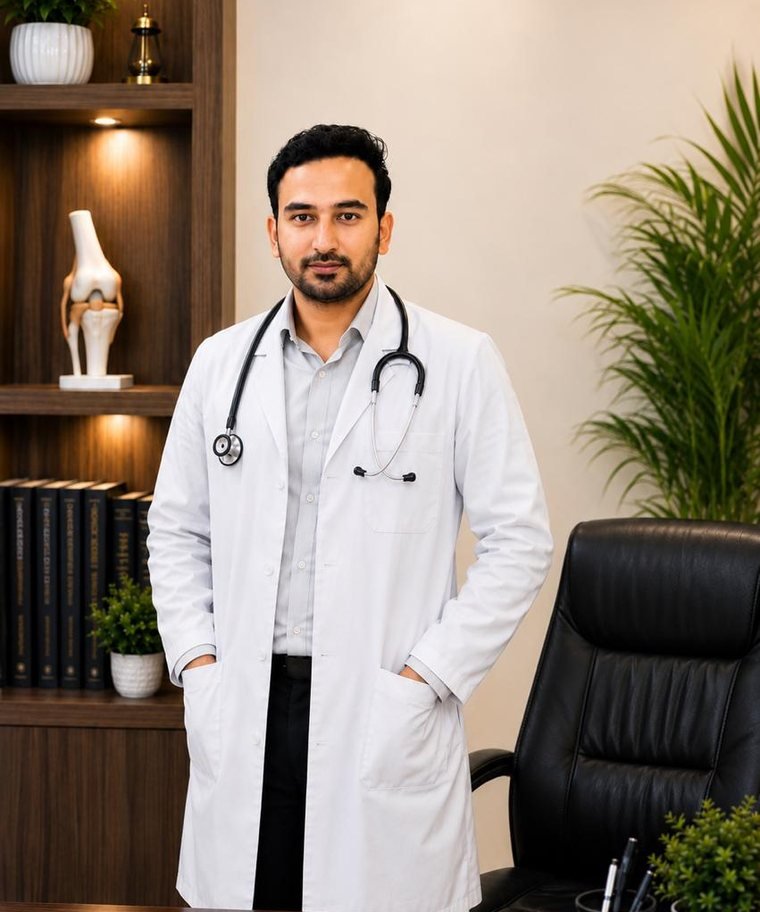
Dr. K. Mohammed Idrees is a consultant orthopaedic surgeon in Bengaluru, treating joint arthritis, sports injuries and fractures in patients of all ages.
He completed his MBBS at Sri Devaraj Urs Academy of Higher Education, Kolar, and his MS in Orthopaedics at Raja Rajeswari Medical College & Hospital, Bengaluru. He went on to complete an ISAKOS-approved fellowship in shoulder and knee surgery, with advanced training in arthroscopy, knee preservation and personalised kinematic alignment knee replacement.
His work covers outpatient, emergency and operative care, from fracture fixation to knee and hip replacement, and follows evidence-based practice.
Where to consult
Call the hospital and ask for an appointment with Dr. K. Mohammed Idrees, Orthopaedics.
RT Nagar
OPD7:00 – 9:00 pm
Shivajinagar
OPD5:00 – 7:00 pm
KG Halli
OPD9:00 am – 4:00 pm
Hebbal
OPDBy appointment
Conditions & treatments
Choose an area to see common problems, the symptoms that bring people in, and the usual treatment options. Many problems settle without surgery. Treatment is decided after an examination and, where needed, X-rays or an MRI.
Sports medicine
Usually a twisting injury during sport, followed by swelling. The knee may feel unstable or "give way" afterwards.
Treatment: physiotherapy, or arthroscopic ACL reconstruction using a tendon graft from your own thigh (hamstring or quadriceps tendon).
Sports medicine
Pain along the joint line, catching, or the knee locking and not straightening fully.
Treatment: rest and physiotherapy for minor tears; arthroscopic meniscus repair where the tear can be repaired, or trimming of the torn part where it cannot.
Knee preservation
Knee pain and swelling with activity, often in younger or active patients, before arthritis becomes advanced.
Treatment: activity changes, strengthening and injections, or arthroscopic and alignment-correcting procedures that aim to protect your own joint and delay the need for replacement.
Joint replacement
Daily pain, stiffness and difficulty walking or climbing stairs that no longer respond to medicines or physiotherapy.
Treatment: total knee replacement, including personalised kinematic alignment (explained below).
Arthritis
Pain in the groin or thigh, stiffness, a limp, and difficulty putting on shoes or sitting cross-legged.
Treatment: medicines, physiotherapy and activity changes at first; total hip replacement when pain limits daily life.
Blood supply
Loss of blood supply to the ball of the hip joint, causing groin pain that slowly gets worse.
Treatment: depends on the stage; total hip replacement once the joint surface has collapsed.
Joint replacement
The worn ball and socket of the hip are replaced with artificial parts. Most patients start walking with support soon after surgery.
Recovery: a guided physiotherapy programme in the weeks after surgery.
Tendon
Shoulder pain, often worse at night, and weakness when lifting the arm. Common after a fall or with age-related wear.
Treatment: physiotherapy and injections for some tears; arthroscopic rotator cuff repair for tears that need fixing.
Sports medicine
The shoulder slips out of the joint, sometimes repeatedly, or feels loose during certain movements.
Treatment: physiotherapy, or arthroscopic stabilisation to repair the torn tissue that holds the joint in place.
Stiffness
Gradual pain and stiffness until the arm is hard to lift or turn. More common in people with diabetes.
Treatment: physiotherapy, medicines and injections; arthroscopic release for the few cases that do not improve.
Trauma
Broken bones of the wrist, arm, leg, ankle and hip from falls, sports or road accidents.
Treatment: a plaster cast where suitable, or surgical fixation with plates, screws, nails or an external fixator.
Wrist
One of the most common fractures, usually from a fall on an outstretched hand.
Treatment: cast, plate fixation or an external fixator, chosen by the fracture pattern and your age and activity level.
Sports & general
Ligament sprains, tendon injuries and joint pain that has not settled after a few weeks.
Treatment: examination, imaging if needed, and a treatment and physiotherapy plan.
Knee replacement
Every knee has its own natural angle. In a conventional knee replacement, the implant is usually set to the same straight alignment for every patient.
Kinematic alignment aims to place the new joint along the angle your knee had before arthritis set in. The goal is to keep the ligaments working the way they naturally did, so the knee moves more like your own.
Whether this approach suits you depends on your knee's shape and condition, and is discussed at consultation.
For a serious injury, a suspected fracture, a badly deformed joint, or a wound with bone showing, go straight to the nearest hospital emergency department. Do not wait for an outpatient appointment.